
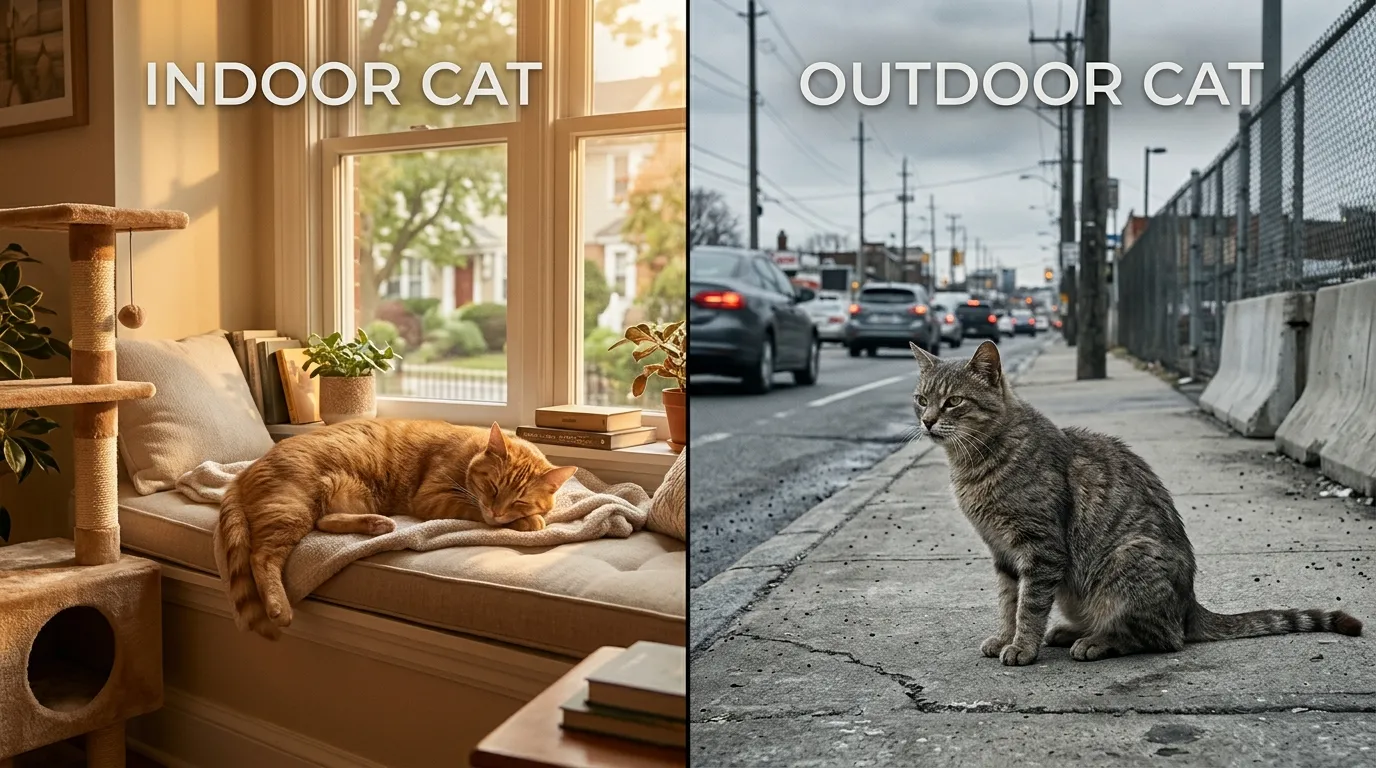
I watched a neighbor lose two cats to traffic in three years while her indoor cat, the same age as the first, sailed into his sixteenth birthday without a single serious health problem. The indoor vs outdoor debate comes up every time someone gets a new cat, and guilt and sentiment muddy it more often than facts settle it. The indoor cat vs outdoor cat lifespan gap is wide, and nobody who works with cats seriously disputes its direction. Indoor cats live far longer. This article covers why the gap exists, what drives it on both sides, the numbers you can trust and the ones you should treat carefully, and what the verdict means for your cat.
Indoor cats live an average of 12 to 18 years. Free-roaming outdoor cats are commonly cited at 2 to 5 years. That gap of roughly 10 years comes from cumulative exposure to traffic, infectious disease, predators, toxins and territorial injury. Indoor cats win on lifespan. For most owners the better question is how to make indoor life genuinely stimulating.
Quick comparison
| Lifestyle | Typical Lifespan | Main Risks |
| Fully indoor | 12 to 18 years, often into the 20s with good care | Obesity, boredom, urinary and dental problems |
| Indoor with catio or harness walks | Closer to fully indoor than to free-roaming | Escape risk, parasites if exposed to soil and plants |
| Indoor-outdoor, unsupervised | Lower than indoor; varies with area and traffic | Same hazards as outdoor cats during every outing |
| Free-roaming outdoor | Commonly cited at 2 to 5 years in urban and suburban areas | Traffic, FIV and FeLV, toxins, predators, fights |
What the Indoor Cat Lifespan Looks Like and What Drives It?
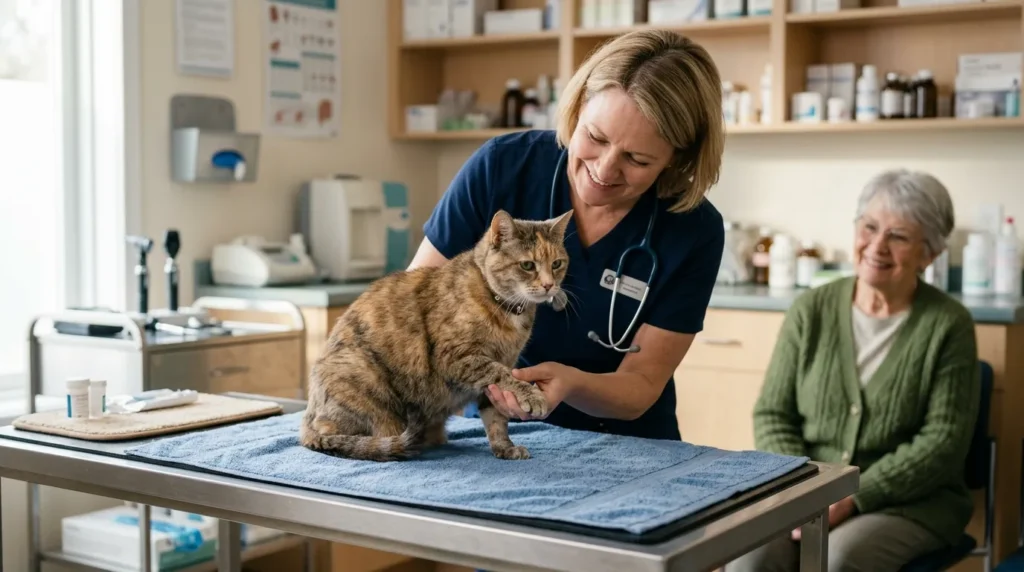
Indoor cats live an average of 12 to 18 years, and well-cared-for cats regularly reach 20 and beyond. The advantage doesn’t come from the indoors itself. It comes from removing the specific risks that kill outdoor cats young and adding regular veterinary monitoring that catches disease early enough to treat.
Preventive veterinary care is the biggest driver of indoor cat longevity after physical safety. An indoor cat with annual wellness exams and bloodwork gets chronic kidney disease, hyperthyroidism and early diabetes caught while they’re still manageable. Outdoor cats with the same conditions rarely get the monitoring that would find them early.
 Spay and neuter status adds to indoor cat lifespan, and indoor cats get it done more consistently. Intact female cats face higher risks of mammary tumors and pyometra, a uterine infection. Intact males roam, fight and get injured even when they’re nominally kept indoors. Spaying and neutering cut or remove those risks, and the cats tend to be calmer at home.
The cats I’ve seen live into their late teens almost all shared two things. They were spayed or neutered early, and their owners noticed small changes quickly. The indoor environment protects, but the owner’s attention is what extends the life.
How old is the oldest cat?
Guinness World Records lists Creme Puff, a Texas cat, as the oldest at 38 years and 3 days. She’s an extreme outlier, not a target, but she lived indoors with a very attentive owner.
Health risks indoor cats do face
Indoor life isn’t risk-free, and a fair comparison says so. The common problems are manageable, and most of them trace back to setup and routine.
| Indoor Risk | What Helps |
| Obesity | Measured meals, daily play, a body condition check at each vet visit |
| Urinary tract problems | Clean litter boxes, fresh water, low-stress routines |
| Dental disease | Regular brushing and vet dental checks |
| Boredom and stress | Play sessions, climbing space, window access |
Feeding your indoor cat properly, brushing your cat’s teeth at home and staying on top of indoor cat health cover the first three rows in detail.
What the Outdoor Cat Lifespan Looks Like and Why It’s So Short?
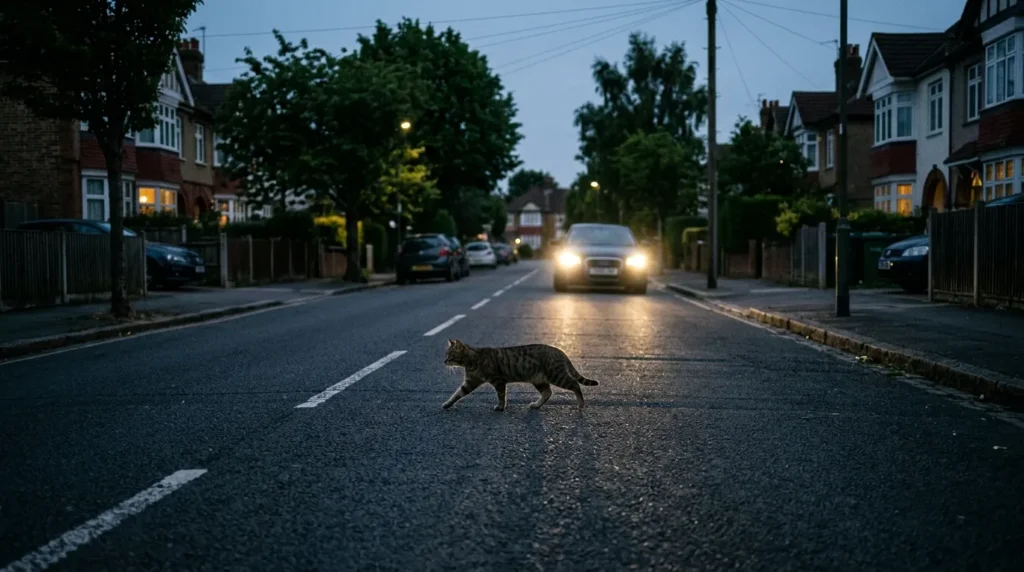
Free-roaming outdoor cats are commonly cited at 2 to 5 years of life in urban and suburban areas. That number reflects threats that show up daily and compound over time. No single one kills most outdoor cats. The combination does.
A caution on the figure itself. The 2 to 5 year range is widely repeated, but it applies to unowned or unsupervised free-roaming cats, and published estimates vary by region and study. Owned outdoor cats with vaccinations and vet care can live longer than that. They still trail indoor cats, and the direction of the gap holds across the research.
Traffic is the leading cause of premature death in outdoor cats in urban and suburban areas. Cats are crepuscular, most active at dawn and dusk, and those are the hours with the heaviest traffic. A cat that crosses a road twice a day makes thousands of crossings in a lifetime, and the odds catch up.
Infectious disease is the second major factor. Feline immunodeficiency virus (FIV) spreads mainly through bite wounds, usually in territorial fights. Feline leukemia virus (FeLV) spreads through bites too, along with saliva, shared bowls and mutual grooming. Neither is curable. Both can progress slowly enough that an infected cat looks healthy for years while its immune system weakens. A cat that never goes outside and never meets an infected cat has essentially no exposure pathway, and vaccination (available for FeLV, not for FIV in most regions) is a backup, not the plan.
Toxins and parasites round out the list. Rodenticides, slug bait and antifreeze kill cats whose deaths often go unattributed, and outdoor cats pick up fleas, ticks and intestinal parasites that indoor cats rarely meet.
| Outdoor Risk | How It Harms | Indoor Cat Exposure |
| Traffic | Fatal or disabling injury | None |
| FIV and FeLV | Incurable, weakens immune system | Negligible |
| Rodenticide, slug bait, antifreeze | Poisoning | Only if stored in the home |
| Predators | Attacks, depending on region | None |
| Fights and weather | Wounds, abscesses, exposure | None |
Indoor Cat vs Outdoor Cat Lifespan: Where the Real Gap Comes From?
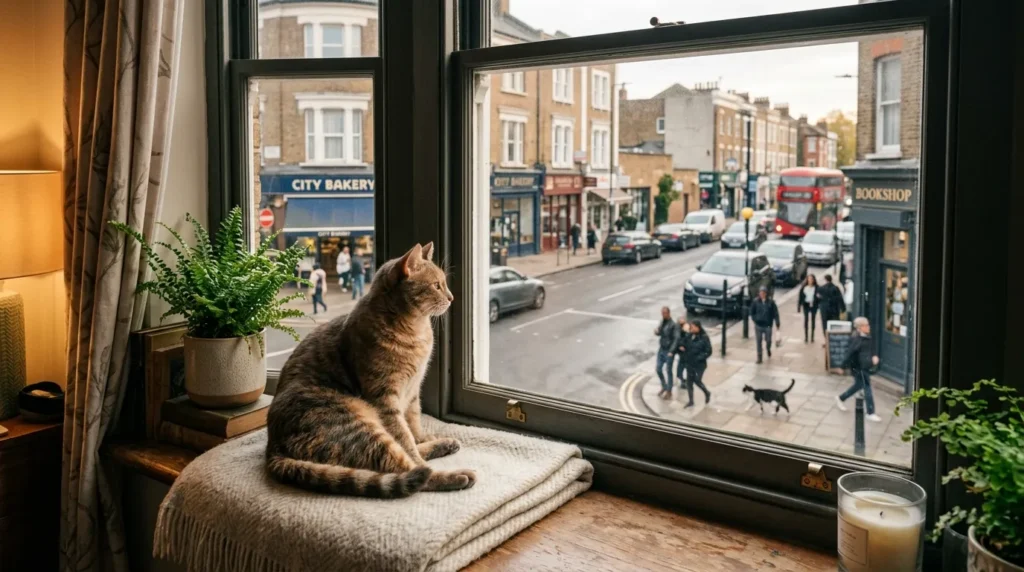
The gap comes from five risk categories that outdoor cats face and indoor cats mostly avoid. Traffic and direct injury account for the largest share of early outdoor deaths. Infectious disease from bite wounds and contact with infected cats follows. Toxins like rodenticide, slug bait and antifreeze cause deaths that often go unattributed. Predator encounters and extreme weather make up the rest.
Indoor cats skip the whole list at once. A cat that avoids traffic, FIV, toxins, predators and fighting gains more than a decade of expected life over a cat exposed to all of them. Protection works because it’s complete.
One category deserves its own mention: indoor-outdoor cats. Cats with supervised or limited outdoor access, including enclosed gardens and catios, show lifespans closer to fully indoor cats than to free-roaming ones. Outdoor air and sunshine aren’t the danger. Unsupervised roaming among traffic, other cats and human-made hazards is.
Which Setup Produces a Better Long-Term Outcome for Your Cat
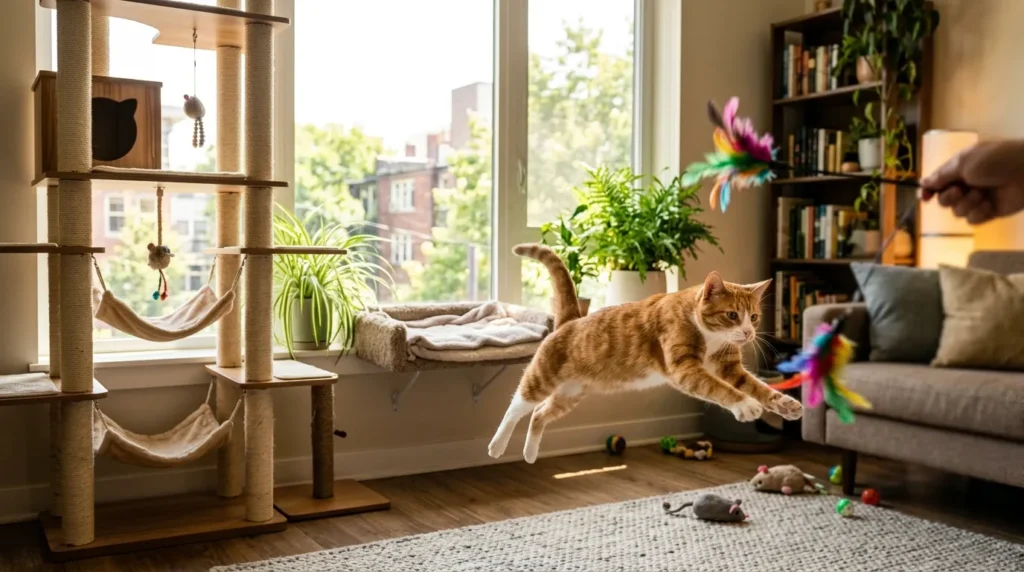
Indoor life gives a better long-term outcome on lifespan and disease exposure when the indoor setup is right. That condition matters. An under-enriched indoor cat can end up with worse behavior and weight problems than a well-managed outdoor cat, even though she’ll probably still live longer.
 A well-enriched indoor cat gets daily interactive play, vertical climbing space, window stimulation and a steady routine. That covers the behavioral needs outdoor cats meet by roaming: hunting, climbing, scouting and scratching. The Ohio State University Indoor Pet Initiative publishes enrichment guidance on how to meet those needs indoors.
The claim that outdoor cats are freer or happier usually compares them with a bored indoor cat. A bored cat looks unhappy because she is. A cat with climbing space, daily play and a window perch looks like what she is, a cat with what she needs. The real comparison is a good setup against a bad one.
Indoor enrichment checklist
- Two or more play sessions a day with a wand or similar toy, 10 to 15 minutes each
- At least one tall perch or cat tree near a window
- A scratching post tall enough for a full stretch
- Food puzzles or scatter feeding for part of the daily meal
- One litter box per cat plus one extra, cleaned daily
- Rotating toys, so the same ones don’t sit out all week
Indoor cat enrichment ideas, cat furniture that gives vertical space and reading your indoor cat’s behavior turn this checklist into a daily routine.
The One Mistake People Make When Comparing Indoor and Outdoor Cat Lives
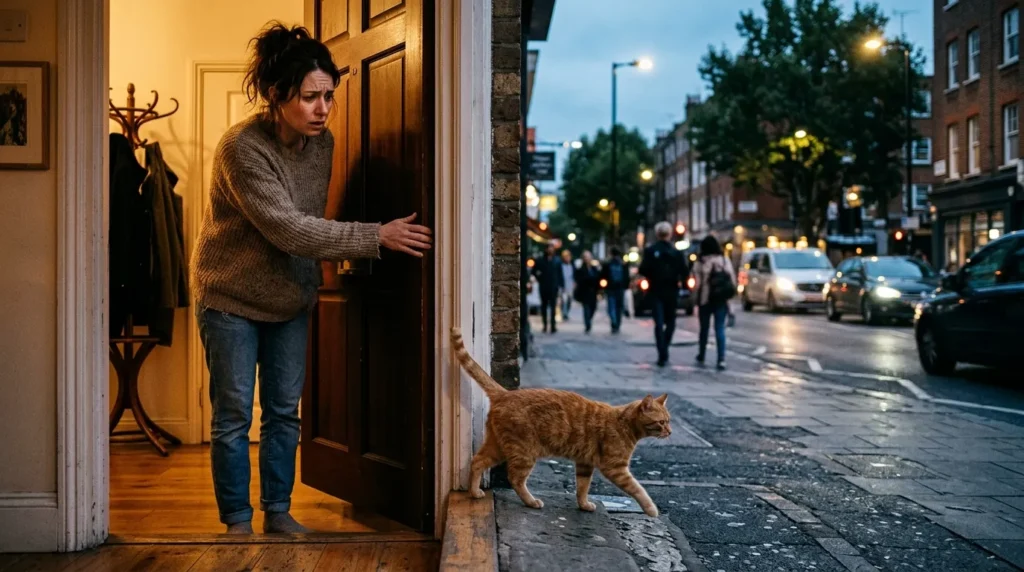
The common mistake is treating this as a lifestyle preference instead of a risk question. People frame it as freedom against restriction, then feel guilty about keeping their cat inside. That framing hides what’s really happening.
Unsupervised roaming in a suburban or urban area exposes a cat to a risk profile that shortens its life by roughly a decade. A cat doesn’t experience that as freedom, any more than a person walking across a motorway experiences it as adventure. She can’t weigh the risk.
The mistake grows when owners treat occasional outdoor access as a compromise. A cat with occasional unsupervised access carries the same exposure as a fully outdoor cat for every minute she’s out. Fewer outings means fewer chances for something to go wrong, and a cat only needs one bad crossing. Real protection comes from removing the risk categories, not thinning them.
Safe Ways to Give Your Cat Outdoor Experience
Owners who feel guilty about keeping a cat inside have options between “indoor only” and “free roaming.”
| Option | What It Gives | Watch Out For |
| Catio or enclosed balcony | Fresh air, sounds, birdwatching, no roaming | Gaps in mesh, and a roof that cats can’t climb out of |
| Harness walks | Exploration with you in control | Escape-proof harness fit and slow training |
| Window perch with bird feeder outside | Daily visual stimulation | Frustration in some cats if they can’t reach prey |
| Secure garden fencing for cats | Space to roam within limits | Standard fences don’t stop climbers |
How to Move an Outdoor Cat Indoors?
For cats already used to roaming, the shift needs a gradual process over several weeks, not an abrupt lockdown. The adjustment is real and manageable.
- Add what the cat was getting outside. Set up perches by windows, scratching posts and a place to hide before you restrict access.
- Shorten outdoor time. Cut a little each week and replace it with scheduled play and meals at the same times she used to go out.
- Fill the gap with play. Two or more wand sessions a day, ending with a food reward, mimic the hunt.
- Keep the routine steady. Feeding and play at fixed times reduce stress.
- Watch for door dashing. Keep doors shut, and think about a microchip and ID tag in case she gets out.
- Call the vet if behavior worsens. Constant yowling, litter box avoidance or appetite loss need a check, not just patience.
Our Verdict: What the Evidence Recommends for Most Owners
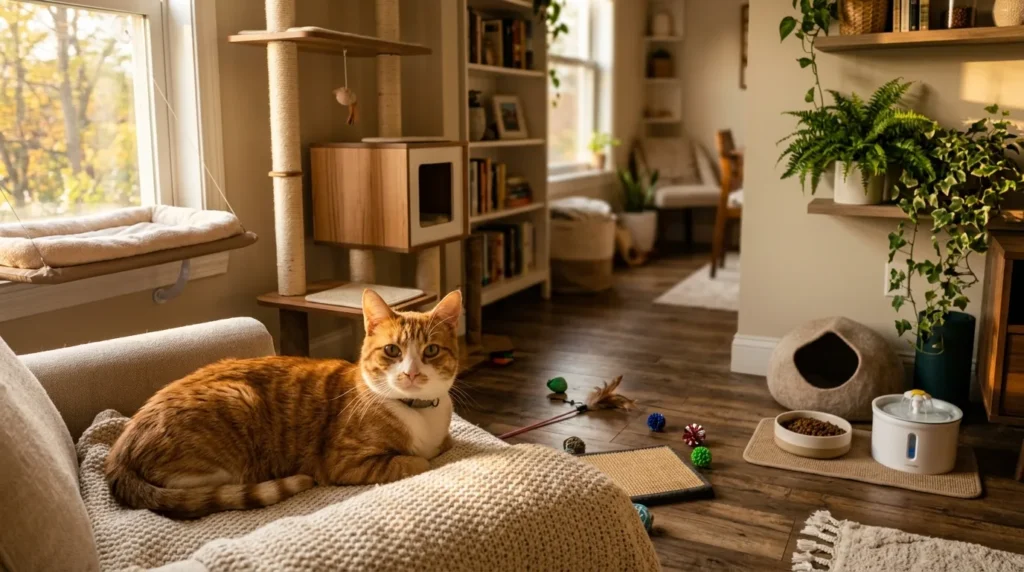
For cats in urban and suburban areas, indoor life wins on lifespan and disease exposure. The advantage is large, the disease exposure is close to zero and enriched indoor cats get their behavioral needs met. I’ll concede the one point on the other side: an indoor cat in a bare apartment with no play can be miserable. That’s an argument for better enrichment, not for opening the door.
My recommendation is full indoor living with active enrichment for any cat in a traffic-adjacent or densely populated area. Owners who want to give outdoor experience without the roaming risk can use enclosed catios and supervised harness walks, which give the sights and smells without the mortality risk.
Frequently Asked Questions About Indoor and Outdoor Cat Lifespan
How long do indoor cats live compared to outdoor cats?
Indoor cats live an average of 12 to 18 years. Free-roaming outdoor cats are commonly cited at 2 to 5 years in urban and suburban settings. The gap reflects cumulative exposure to traffic, infectious disease, toxins and injury, not any single cause.
What is the average lifespan of an indoor cat?
12 to 18 years, with many reaching 20 when they get regular vet care, a healthy weight and a good diet.
Why do indoor cats live so much longer than outdoor cats?
Indoor cats avoid the five main causes of early outdoor death: traffic, bite-transmitted disease like FIV and FeLV, toxins, predators and territorial injury. They also get steadier vet care, which catches kidney disease, diabetes and hyperthyroidism early.
Is it cruel to keep a cat indoors?
No, if the home is set up properly. Daily play, climbing space, window access and a stable routine meet a cat’s behavioral needs. Cruelty comes from neglect, not from the indoors.
Do indoor cats get depressed from not going outside?
Under-enriched indoor cats can show boredom, overgrooming, aggression or lethargy. Well-enriched indoor cats don’t show those signs because they have outlets for hunting and climbing. If your cat seems withdrawn, get a vet check as well, since illness often looks like mood.
Is an indoor-outdoor cat a good compromise?
Unsupervised access carries the same traffic and disease risks as a fully outdoor cat for every minute spent outside. Enclosed catios and supervised harness walks give outdoor experience without that risk.
What actually kills most outdoor cats?
Traffic is the leading cause in urban and suburban areas. FIV and FeLV are the main infectious causes. Rodenticide and antifreeze poisoning account for many deaths that go unexplained.
Can an outdoor cat become an indoor cat?
Yes. Most adapt over a few weeks if you add perches, play and a steady routine before cutting outdoor time. See the transition steps above.
Do indoor cats still need vaccinations and vet visits?
Yes. Core vaccines, rabies where the law requires it, and annual wellness exams still apply. Indoor cats can catch illness from a new pet, from your shoes or after a missed door. Ask your vet which vaccines fit your cat’s risk.
This article is for informational purposes only. Always consult your vet if you have concerns about your cat’s health.
Conclusion
Indoor cats live roughly 10 years longer on average, and specific, preventable risks drive that gap, not genetics or luck. Make the indoor environment work and the advantage becomes real. Pick one enrichment element your cat doesn’t have yet, such as a window perch or a food puzzle, and add it this week. For the full setup, see our guide to making your home cat friendly from scratch.
Indoor cats live an average of 12 to 18 years, compared with a commonly cited 2 to 5 years for free-roaming outdoor cats in urban and suburban areas. The roughly 10-year lifespan gap comes from outdoor cats’ cumulative exposure to traffic, FIV and FeLV, rodenticide and antifreeze toxicity, predators and territorial injury. Indoor cats with daily interactive play, vertical climbing space and window access can meet their behavioral needs without that mortality risk. Cats with catios or supervised outdoor access fall closer to indoor lifespans. Spayed or neutered indoor cats with regular vet care tend to reach the longest lives.

Written by Mishu
A passionate cat lover and indoor living enthusiast, Mishu is the founder and voice behind Indoor Living Cat – a go-to resource for cat owners who want to create the happiest, healthiest life for their feline companions indoors.
View Full Profile